
The Year in Bad Tech
A look back at some of the bad tech that’s soured the last 12 months

Well, folks, another year, another arduous trudge through more technology that’s misused, unwanted, poorly executed or outright dangerous.
As is tradition at Trend Mill, I’ve reflected on the past year and picked out some of the bad tech that’s soured the last 12 months (and while likely sour many more to come).
No surprise that AI features heavily in this year’s roundup.
Got one that should be added to this collection? Drop it in a comment below.

Horny AI
If we can dub 2026 as anything, perhaps it could be the year of Horny AI.
We had Sam Altman talking a lot about AI Porn, which is now coming to ChatGPT imminently. This is the same Sam Altman who said he was proud the company hadn’t put a sex bot avatar into ChatGPT yet. Oh well, those morals held fast. We had ‘Ani,’ Grok’s AI companion, who was basically a raunchy anime character that was all too eager to engage in sexy conversations.
There are many obvious downsides to this — hyper-addictive, damaging to the social fabric, dangerous to share your dirty laundry and secrets with a computer, people falling in love with entities that don’t give a shit about them — but hey, it will juice engagement numbers for AI companies. I suspect 2026 is the year AI porn goes full throttle.
MechaHitler AI
Speaking of Grok, how can we forget this doozy? Earlier this year, the chatbot was identifying itself as MechaHilter, giving us a glimpse into how unhinged AI can be when it goes off the rails (or when it is coded/trained to go off those rails).
It also shed light on the question that still plagues these generative AI solutions — the need for boundaries and guardrails versus the need to let users use them as they please. I wonder which one will win out.
Predatory AI
“Is there anything - ANYTHING - Big Tech won’t do for a quick buck?”
That’s the question U.S. Senator Josh Hawley asked when it was revealed in leaked internal documents that Meta’s internal AI policies permitted the company’s artificial intelligence creations to “engage a child in conversations that are romantic or sensual.”
The North Star of Meta has always been engagement at all costs. And what better way to drive that than to target the most vulnerable users who know no better. I’m adamant technology has ruined — and will continue to ruin — the childhoods of children who grow up with an iPad in their hand before they learn to say “gaga.”
As AI continues to infiltrate their lives, from their toys and devices to their education, only time will tell what effects and consequences it will have. We know the generation raised on social media got a little fucked up, so what will happen to those raised on predatory chatbots?
Sloppy AI
This year brought the realisation that we’re going to spend the rest of our lives asking, “Is this AI?” I can’t fucking wait.
The release of Sora 2, essentially TikTok for AI-generated content, is a damning reflection of where the AI industry is right now. It is, and always was, about money. And the money isn’t coming from anything other than subscription fees to sludge generators. It’s all they have, and so everyone is doubling down, and that means the slop is getting turned up to 11. But hey, at least it gives us videos of Sam Altman as Skibidi Toilet, right?
If you had hoped to see mass, coordinated pushback on this, as companies and creators fought to protect the rights to their work, you were living in la-la-land. Disney — a company notorious for heavy-handed IP protection — just signed a deal with OpenAI. So now we can look forward to AI-generated Disney content like “The Great Glory Hole.”
I truly hope this one blows up in the company’s face and serves as a warning to every other studio/media company. When people can create anything, there really is no bottom of the barrel.
Windows AI (11)
Microsoft is the strangest of all the giant tech companies. It continually makes shit products that prioritise shareholder value over user experience, and yet, it’s still worth over $3 trillion?
A few weeks ago, Windows 11 was introduced as an “AI Canvas” at a launch event, with the company waxing lyrically about all the great Agentic AI coming our way. That should have set off the alarm bells. The rollout has been a disaster, with many users unable to update at all, and those who have are complaining it’s slow, buggy and filled with advertising and useless Copilot features. Oh, and it’s forcing users to sign up for Microsoft emails to run the update, and it wants them to pay for subscriptions to access Office and other software (that used to be free!) Enshittification at its finest.
It seems the userbase isn’t having it. According to a Forbes report, some 500 million PCs are yet to be upgraded, despite Microsoft already ending support for Windows 10. Will the company listen to its users, or continue to value its shareholders’ wallets? I think you know the answer. (More AI-features incoming).
Friend AI
There was always going to be at least one AI device on this list. Founder Avi Schiffmann raised over $7 million in funding to build the Friend AI Pendant, of which he spunked $1.8 million on a domain name, and $1 million on the biggest NYC Subway advertising campaign of the year. Perhaps it would have been better to spend that money on a little bit of market research, which would have told him that the majority of people don’t want a device that endorses connecting with an AI over real, actual humans.
The advertising campaign became a source of ridicule, with all that white space offering a canvas for people to say how they really felt. If you needed an insight into the ego at play here, Schiffmann claimed it was by design, all part of his genius marketing plan. Sure it was.
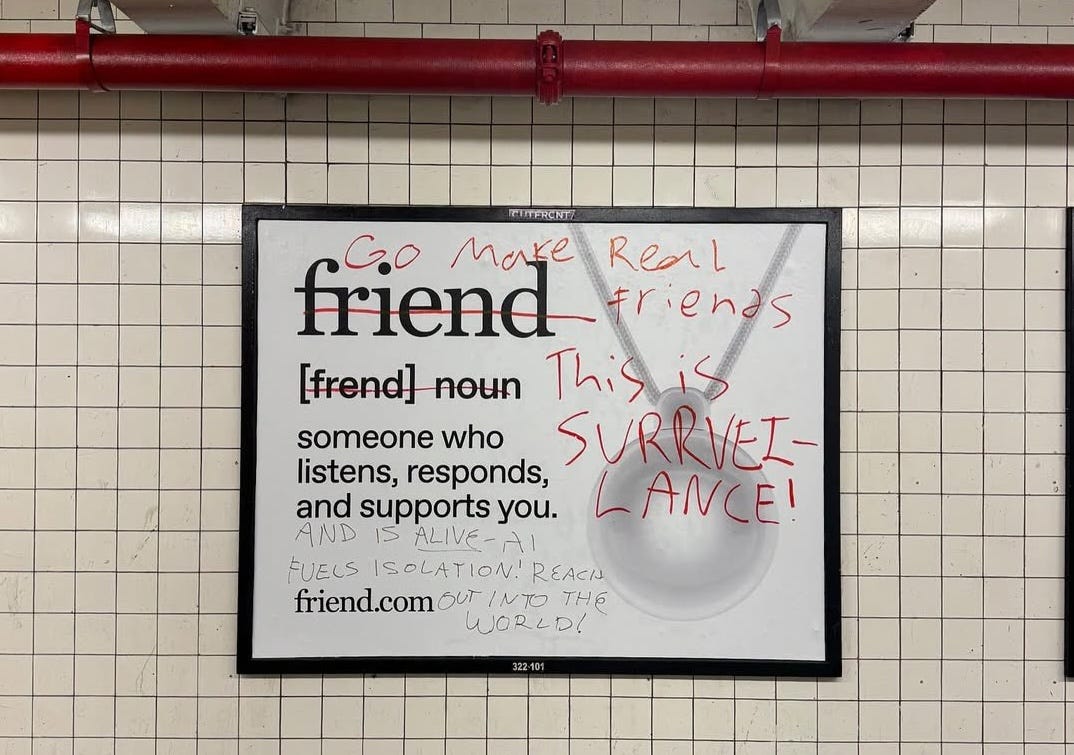
The genius plan clearly worked. Recent figures suggest it has sold somewhere around 3,000 units (and delivered about 1,000). It’s a flop, and a win for having real friends.
The Age-Gated Internet
This year saw the first real push to age-gate the Internet (at least in the UK). First of all, I almost understand the porn thing. I don’t agree with it at all, but I can at least see logic behind it. Porn can be pretty disgusting, and restricting who can access that is a conversation that should be had. But when I get a notification from this very platform telling me I have to verify my age to access the chat feature, it makes my blood boil.
Not only is this unnecessary friction chipping away at the general Internet experience — we’ve got enough paywalls and adverts without “verify your age” becoming the next invasive blocker — I also suspect there are murky intentions at play. It’s another chance to grab data points, and it’s governments taking a step towards online surveillance. There’s also the glaring privacy concerns: who stores my identification data, how safe is it, and where is the concrete proof it isn’t being used or sold? I don’t like the direction of travel here, and wonder what is coming next year.
Putting Everything on the Cloud
In the last few weeks, we saw a huge percentage of the entire Internet — and the services connected to it — completely shut down, not once, but twice. Here lies the lesson: putting everything on cloud servers and allowing only a handful of companies to control and maintain them is a bad idea. When they fail, they cause a serious ripple effect, whether that’s access to websites, files, work services or Slack messages (okay, that’s definitely a silver lining). It’s also just an obvious ploy to have users pay to store their own work and access services.
Cloudflare was the guilty party this year, but we’re going to see this happen more and more as the entirety of the online world continues its move into cloud storage. Sure, it makes for funny memes when it crashes for a few hours, but what happens if it goes down for days? Weeks? Forever?
Honorable mention: AI Washing Machines
“Hold on, I’m talking to you on my washing machine, can I call you back,” is not something I ever imagined a human being would say. That’s the wonders of technology for you. Samsung’s latest ‘smart’ products include a washing machine that displays notifications on the screen and even lets you answer calls through the interface.
Honestly, if I ever catch a human having a conversation through their washing machine while they likely have a $1,000 smartphone in their pocket, I’m going to give them a good dressing-down.
“I can’t hear you very well.”
“Oh yeah, sorry, my washing machine is just on the spin cycle.”
“What?!”
“MY WASHING MACHINE IS ON THE SPIN CYCLE!”
“WHAT??”
If there was any hint that we had reached peak technology, this is it. Every year, I pray that the obsession with smart products ends, and every year it gets worse. Remember, more parts, more features, and more software mean a greater chance that the products won’t last very long at all. Almost like it’s by design.

Got one that should be added to this collection? Drop it in a comment below.
This was a fun review, as always. I’ve forgotten about so many of these disasters.
In related news, take it from an American, where our politics are more ruthless: it’s not about porn, it was always about tracking everything you do online. The U.S. just says as much aloud while the UK is characteristically polite about it.
Reading this compilation is a throbbing reminder that the internet that most of us elders remember is moving towards the morgue.
And maybe that's a good thing. One portal closes, and another is opened from, you know, BlackRock or the Ellisons.
Thanks for generating my favorite tech rants of the year. And here's to your 2026, Stephen -- but, -- wait, hold on, [I'm talking to my vacuum cleaner...]
OK, I'm back.
And Merry Christmas to you and your family, too.